

Why Multi-Pathogen Screening Matters in Clinical Research
A cough, sore throat and runny nose could be caused by influenza, RSV, a rhinovirus, a coronavirus or one of many other pathogens. Symptoms alone rarely tell you which one.
In clinical care, that uncertainty affects treatment decisions. In clinical research, it can also affect participant safety, study eligibility and the reliability of the data. Multi-pathogen screening, part of our molecular laboratory services, helps address this by investigating multiple potential infectious agents in a single test.
What is multi-pathogen screening?
Multi-pathogen screening uses multiplex molecular testing to look for several pathogens at once, rather than running a separate test for each. A single sample is tested against a panel of targets, and the result shows which of those pathogens were detected.
These tests are qualitative. They tell you whether a pathogen is present, not how much of it there is. That distinction matters, and we come back to it below.
Why it matters in clinical studies
- Participant safety: knowing whether a participant is carrying an infection helps the clinical team make informed decisions about their care and continued involvement.
- Study eligibility: many protocols include criteria about current or recent infections. Screening helps confirm participants meet them.
- Cleaner data: an undetected infection can influence symptoms, immune responses and other measurements. In respiratory research especially, an unrelated infection at the start of a study could make results harder to interpret.
- Infection control: where participants spend time on site, identifying infections early can help teams manage risk to other participants and staff.
- Faster decisions: studies often run to tight schedules. A broad panel with a quick turnaround avoids waiting on a series of separate tests.
How a multiplex respiratory panel works in practice
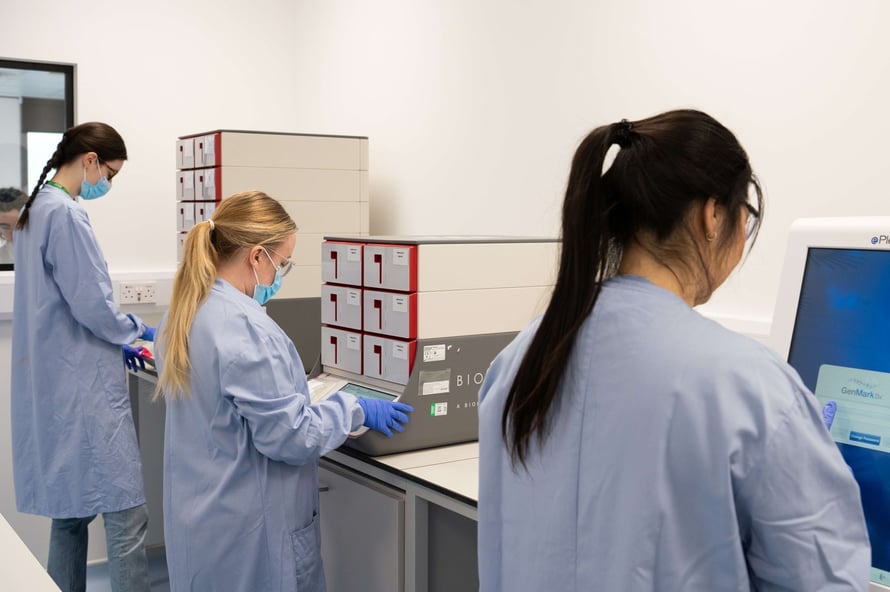
hVIVO uses the bioMérieux BIOFIRE® system for multi-pathogen screening, including the BIOFIRE® Respiratory Panel 2.1, with results often available on the same day.
According to bioMérieux, the RP2.1 panel tests for 22 targets: 18 viruses and 4 bacteria. These include influenza A and B, RSV, SARS-CoV-2, human metapneumovirus, rhinovirus/enterovirus, adenovirus, parainfluenza viruses and other coronaviruses, as well as Bordetella pertussis and Mycoplasma pneumoniae. The manufacturer quotes a run time of around 45 minutes.
When subtype matters: RSV A and RSV B
Sometimes knowing a pathogen is present is not enough. RSV has two main subtypes, RSV A and RSV B, and for some research questions it matters which one is involved.
hVIVO uses the cobas® eplex system from Roche to distinguish between RSV A and RSV B, which can provide additional information when RSV subtype is relevant to the research question.
Screening vs quantification
Multi-pathogen screening answers the question "what is there?" It does not answer "how much?"
When a study needs to measure the amount of a specific virus, for example to track how viral levels change over time, targeted quantitative methods are the better fit:
- qPCR measures the amount of a selected DNA or RNA target by monitoring amplification in real time.
- ddPCR provides absolute quantification of selected targets and may offer improved sensitivity for some low-abundance applications.
Screening gives a broad picture of what is present. Quantitative methods give precise measurement of the targets that matter most to the study. Read more in our guide to qPCR vs ddPCR vs NGS.
Choosing the right panel
No single panel suits every study. The right choice depends on:
- The pathogens of interest
- Sample type and requirements
- Study objectives and how the results will be used
Manufacturer-validated assay performance information is available for these platforms, and the appropriate panel and its suitability should be confirmed for each application. This is something we work through with sponsors during study planning.
How hVIVO can help
Multi-pathogen screening is one part of our molecular laboratory services, alongside qPCR, ddPCR and NGS. Combined with our Virology Laboratory and Microbiology Laboratory capabilities, this lets us support pathogen detection, quantification and characterisation within a coordinated laboratory workflow.
For studies that involve screening participants, our clinical and laboratory teams work together from study design through to reporting. Explore our Clinical Solutions to find out more.
