

qPCR vs ddPCR vs NGS: How to Choose the Right Molecular Technique for Your Study
Choosing a molecular method often starts in the wrong place: the technology. A better starting point is the question you need to answer.
Do you need to measure how much of a known target is present? Detect a target at very low levels? Or look more broadly at genetic material to find changes you did not know to look for? Each question points to a different technique.
This guide covers three of the most widely used molecular methods: quantitative PCR (qPCR), digital droplet PCR (ddPCR) and next-generation sequencing (NGS). It explains how each one works, where it fits and how to choose between them. You can also explore our full range of molecular laboratory services.
Start with the question, not the platform
Before comparing techniques, it helps to be clear on a few points:
- What is the target? A known DNA or RNA sequence, or do you need to investigate genetic material more broadly?
- How much target do you expect? Higher and very low concentrations may suit different methods.
- What type of result do you need? A relative measure, an absolute count or sequence-level detail?
- What sample type are you working with? Blood, serum, plasma, tissue and other samples each have their own processing requirements.
- How will the data be used? Exploratory research, a study endpoint or a regulatory submission may need different levels of assay characterisation.
Once these are clear, the choice of technique usually becomes much easier.
Quantitative PCR (qPCR)
What it does: measures the amount of a selected DNA or RNA target.
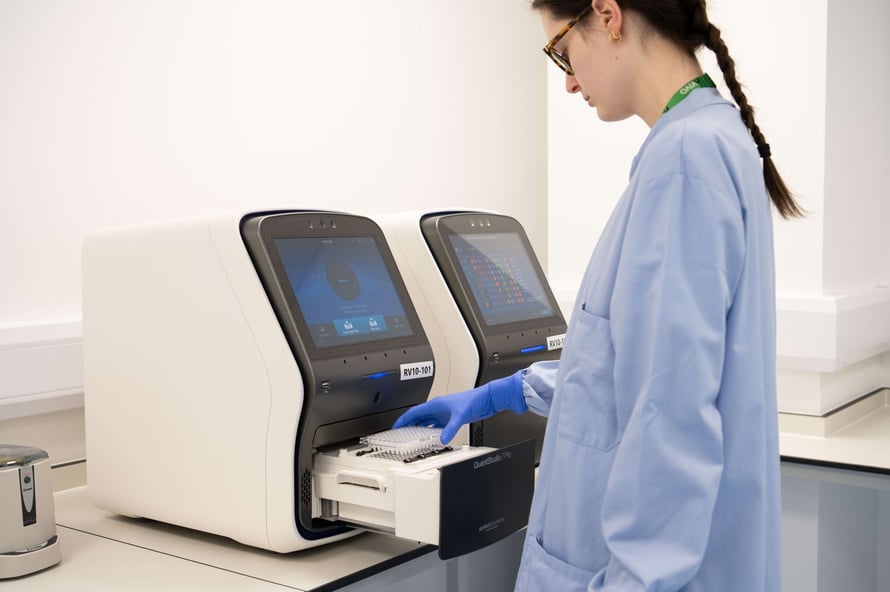
qPCR amplifies a specific genetic sequence and monitors that amplification in real time using fluorescence. The more target present at the start, the earlier the fluorescent signal rises above a set threshold. Quantification is usually made by comparison with a standard curve or reference genes. For RNA targets, a reverse transcription step first converts RNA into DNA (RT-qPCR).
Where it fits:
- Gene expression analysis
- Viral nucleic acid quantification
- Detection of selected genetic targets in research samples
Strengths: well established, relatively fast and suited to processing many samples, with a wide measurement range.
Things to consider: absolute quantification relies on calibration against standards, and precision can be lower at very low target levels.
At hVIVO, we have validated qPCR assays for influenza, enabling us to report their sensitivity, accuracy and reliability to support study planning and interpretation. We are also developing qPCR assays for RSV, hMPV and SARS-CoV-2, with validation anticipated in early 2027.
Digital Droplet PCR (ddPCR)
What it does: quantifies selected targets with high sensitivity.
ddPCR partitions a sample into thousands of individual droplets, with each droplet acting as its own PCR reaction. After amplification, each droplet is read as positive or negative for the target. Statistical analysis of the positive and negative droplets then gives an absolute count of target copies, without the need for a standard calibration curve.
Where it fits:
- Gene expression analysis
- Copy number assessment
- Investigating low-abundance genetic targets
Strengths: compared with conventional qPCR, ddPCR may offer improved sensitivity for some applications, helping researchers investigate lower concentrations of a target. It also provides absolute quantification directly.
Things to consider: it is a targeted method, so you need to know what you are looking for. It may be less suited to samples with very high target concentrations than to those where sensitivity at the low end matters most.
hVIVO uses the Bio-Rad QX700S platform for ddPCR. We are currently developing ddPCR assays for influenza, hMPV, RSV and SARS-CoV-2, and we can also assess the feasibility of project-specific assay development for viral, bacterial or human genetic material.
Next-Generation Sequencing (NGS)
What it does: investigates genetic material in greater detail.
Sequencing determines the order of genetic building blocks in DNA or RNA. NGS analyses many sequences in parallel, allowing researchers to investigate genetic characteristics and variation across a broader range of material than a targeted PCR assay.
Where it fits:
- Whole-genome sequencing (WGS): examining genetic material across a genome
- Genotyping and variant analysis: identifying genetic differences, such as single-nucleotide variants and insertions or deletions
- Microbiome research: investigating the genetic material of microbial communities
Strengths: NGS does not need to be told exactly what to look for, so it is useful for characterising a genome, tracking how a virus changes or finding unexpected variation.
Things to consider: it generates large volumes of data, and making sense of it depends on bioinformatics, suitable reference data and scientific expertise. Turnaround is usually longer than for targeted PCR methods.
At a glance
|
|
qPCR |
ddPCR |
NGS |
|
Best for |
Measuring known targets |
Low-abundance targets and absolute counts |
Broad genetic investigation |
|
Target must be known? |
Yes |
Yes |
No |
|
Quantification |
Usually relative to a standard curve |
Absolute, no standard curve |
Sequence-level detail and variant frequency |
|
Typical uses |
Gene expression, viral load |
Copy number, low-level targets |
WGS, variant analysis, microbiome |
Using techniques together
These methods often work best in combination. NGS might identify a genetic variant of interest across a viral genome. ddPCR can then provide focused, sensitive tracking of that specific marker. qPCR can support routine quantification where a validated assay is already in place.
In antiviral development, for example, NGS can help researchers investigate how a viral genome changes in response to treatment. But a detected variant does not, by itself, establish that a virus has become resistant. Bioinformatics, appropriate reference data and specialist virology expertise help assess its potential significance.
Don't forget the workflow
The technique is only one part of reliable molecular data. Sample handling, nucleic acid extraction and assay setup all influence the result.
Laboratory automation helps standardise repeatable steps and reduce manual intervention, particularly when studies involve multiple samples or repeated assessments. At hVIVO, we use the QIAGEN QIAsprint Connect alongside Hamilton Genomic STARlet and Clinical NGS STARlet systems to support extraction and assay setup for RT-qPCR, ddPCR and NGS library preparation. Read more on our Techniques, Technology and Automation page.
Results need context
Generating data is only part of answering a research question. What the data means depends on the biology under investigation, the study design and how samples were collected and processed. That is why choosing a technique works best as a conversation between the laboratory team and the people who own the scientific question.
How hVIVO can help
Our molecular laboratory services bring together qPCR, ddPCR, NGS and multi-pathogen screening with scientific and biological expertise. We can help you choose the right approach for your target, sample type and study objectives, and interpret findings in the context of your wider programme.
Where a project needs a new or adapted method, our Assay Development and Validation team can help develop and evaluate it for its intended purpose. For virus-focused research, our Virology Laboratory services provide complementary support.
